

托福 cornucopia 真題回顧 1
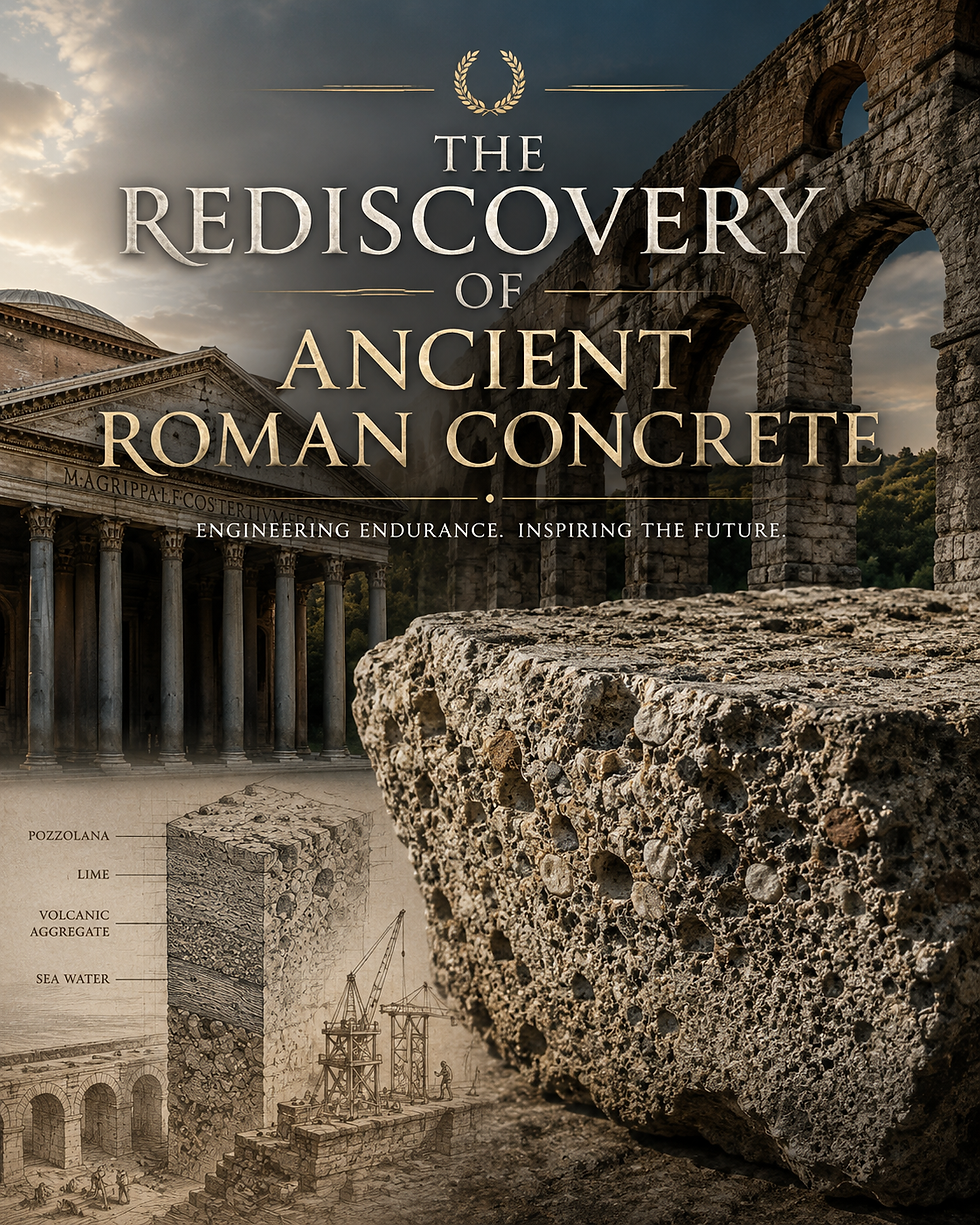
The Rediscovery of Ancient Roman Concrete
Many Roman harbors, bridges, and buildings have survived for two thousand years, although they were exposed to waves, rain, and earthquakes. Their durability has led researchers to examine Roman concrete, made from lime, volcanic ash, water, and rock. Modern concrete also contains cement and stone, but it often develops cracks within several decades, especially in marine environments.
One explanation for Roman concrete’s strength concerns the way its ingredients react over time. When seawater enters tiny cracks, it interacts with volcanic minerals in the concrete. This process can produce new crystals that fill empty spaces and bind the material more firmly together. Instead of simply weakening the structure, limited exposure to water may therefore help repair it.
Researchers have also studied white pieces of lime found throughout Roman concrete. These pieces were once considered evidence of careless mixing. More recent experiments suggest that they may serve an important function. When a crack reaches a lime fragment, water can dissolve part of it and carry the material into the damaged area, where it hardens again.
Scientists do not expect Roman methods to replace construction techniques. However, understanding these ancient materials may help engineers design concrete that lasts longer and requires fewer repairs.
Questions
6. Which of the following best states the main idea of the passage?
(A) Roman buildings survived because they were protected from water.
(B) Researchers are studying how Roman concrete remained durable and may improve modern materials. (C) Modern concrete is made from exactly the same materials as Roman concrete.
(D) Roman engineers understood chemical reactions better than modern scientists.
7. The word “durability” in the passage is closest in meaning to
(A) ability to resist damage
(B) difficulty of production
(C) method of construction
(D) speed of repair
8. According to the passage, how may seawater strengthen Roman concrete?
(A) It removes pieces of volcanic rock.(B) It prevents cracks from developing.(C) It produces crystals that fill spaces in the material.(D) It transforms concrete into a softer substance.
9. Why does the author discuss the white pieces of lime?
(A) To identify a feature once considered a defect that may assist repair
(B) To demonstrate that Roman workers lacked construction skills
(C) To explain why Roman buildings were usually white
(D) To compare volcanic ash with modern cement
10. What can be inferred about researchers studying Roman concrete?
(A) They intend to reproduce every Roman construction method exactly.
(B) They believe all modern concrete should be exposed to seawater.
(C) They are interested in applying certain ancient principles to modern materials.
(D) They have concluded that Roman concrete cannot be scientifically explained.
進階單字片語
單字/片語 | 詞性 | 字義 | 例句 | 例句翻譯 |
be exposed to | phr. | 暴露於;接觸到 | Concrete may weaken when it is repeatedly exposed to seawater and extreme temperatures. | 混凝土若反覆暴露於海水與極端溫度中,可能會逐漸變弱。 |
durability | n. | 耐久性;持久性 | Engineers test the durability of building materials before using them in major structures. | 工程師在將建材用於大型結構之前,會測試其耐久性。 |
concrete | n. / adj. | 混凝土;具體的 | Modern concrete usually consists of cement, water, sand, and stone. | 現代混凝土通常由水泥、水、沙與石頭組成。 |
cement | n. / v. | 水泥; 黏合; 鞏固 | Cement reacts with water and binds the other materials together. | 水泥會與水產生反應,並將其他材料黏合在一起。 |
crystal | n. | 晶體; 結晶 | Tiny crystals form as the cement mixture hardens. | 水泥混合物硬化時,會形成微小的晶體。 |
bind | v. | 黏合; 結合; 束縛 | Chemical reactions bind the particles into a solid mass. | 化學反應會將粒子黏合成堅固的物質。 |
lime | n. | 石灰 | Ancient builders mixed lime with volcanic ash to produce durable construction materials. | 古代建築者將石灰與火山灰混合,以製造耐久的建築材料。 |
dissolve | v. | 溶解 | Some minerals dissolve when they come into contact with acidic water. | 某些礦物接觸酸性水時會溶解。 |
Answers:BACAC

留言